Your ICP Is Just a Document Until It Changes These Three Things
How to create an ideal customer profile (ICP) for B2B SaaS from your best customers' behavior – with a template, a worked example, and the three changes that prove it's working.
By Ilia Markov, B2B SaaS Growth Leader & Advisor
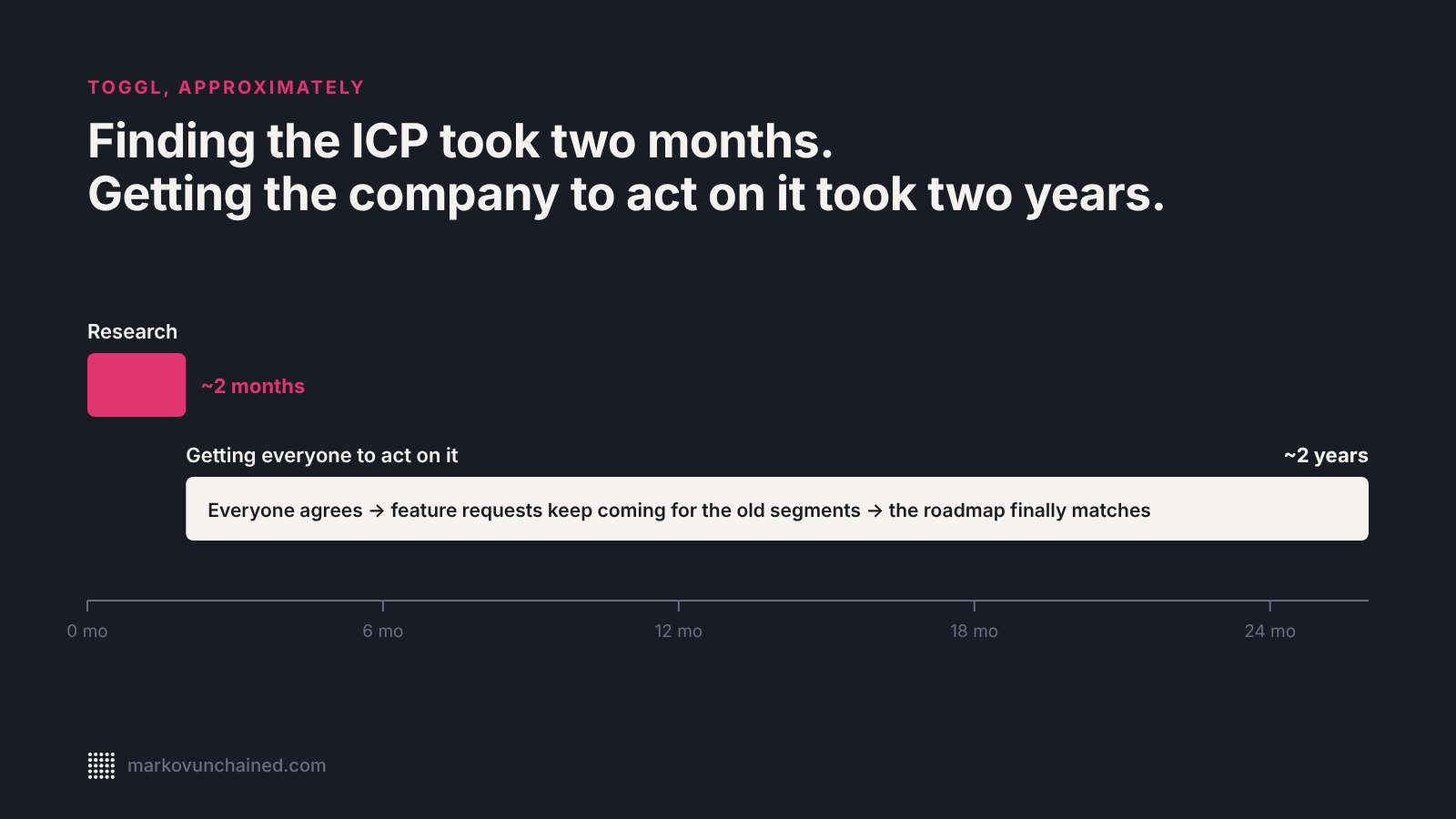
When I joined Toggl, our website promised time tracking for everyone – freelancers, small companies, big companies. It took about two months of customer research to find out who our best customers were. It took about two years before the company acted like it.
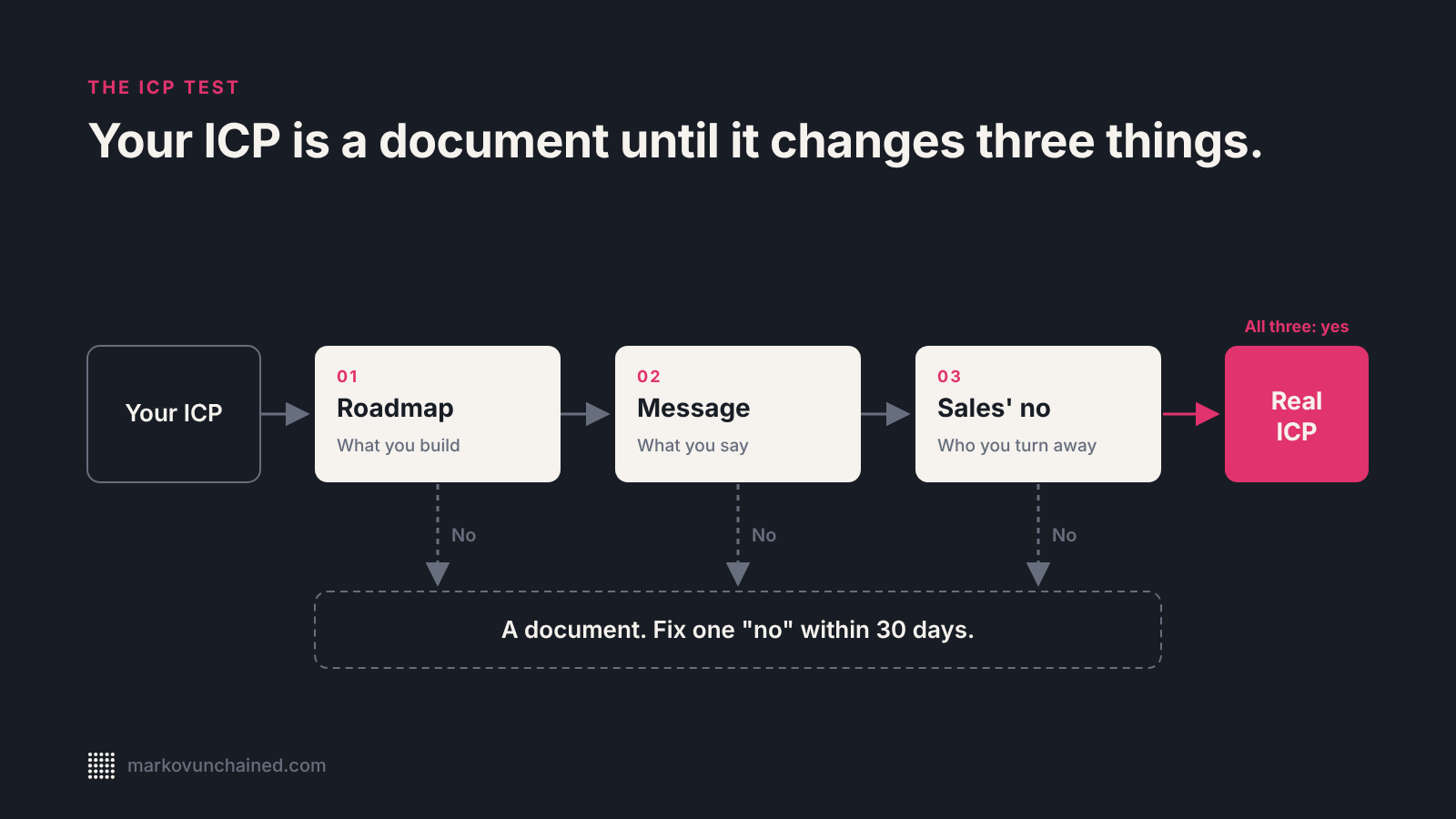
That gap is where most ideal customer profiles die. The research is the part every guide covers, and this one covers it too – the definition, the steps, a template, an example. Then it covers the part they skip: an ICP is only real once it changes three things – what you build, what you say, and who you say no to. Until then, it's a document.
What is an ideal customer profile (ICP)?
An ideal customer profile is a description of the type of company that gets the most value from your product, stays the longest, and costs the least to win. It describes companies, not people.
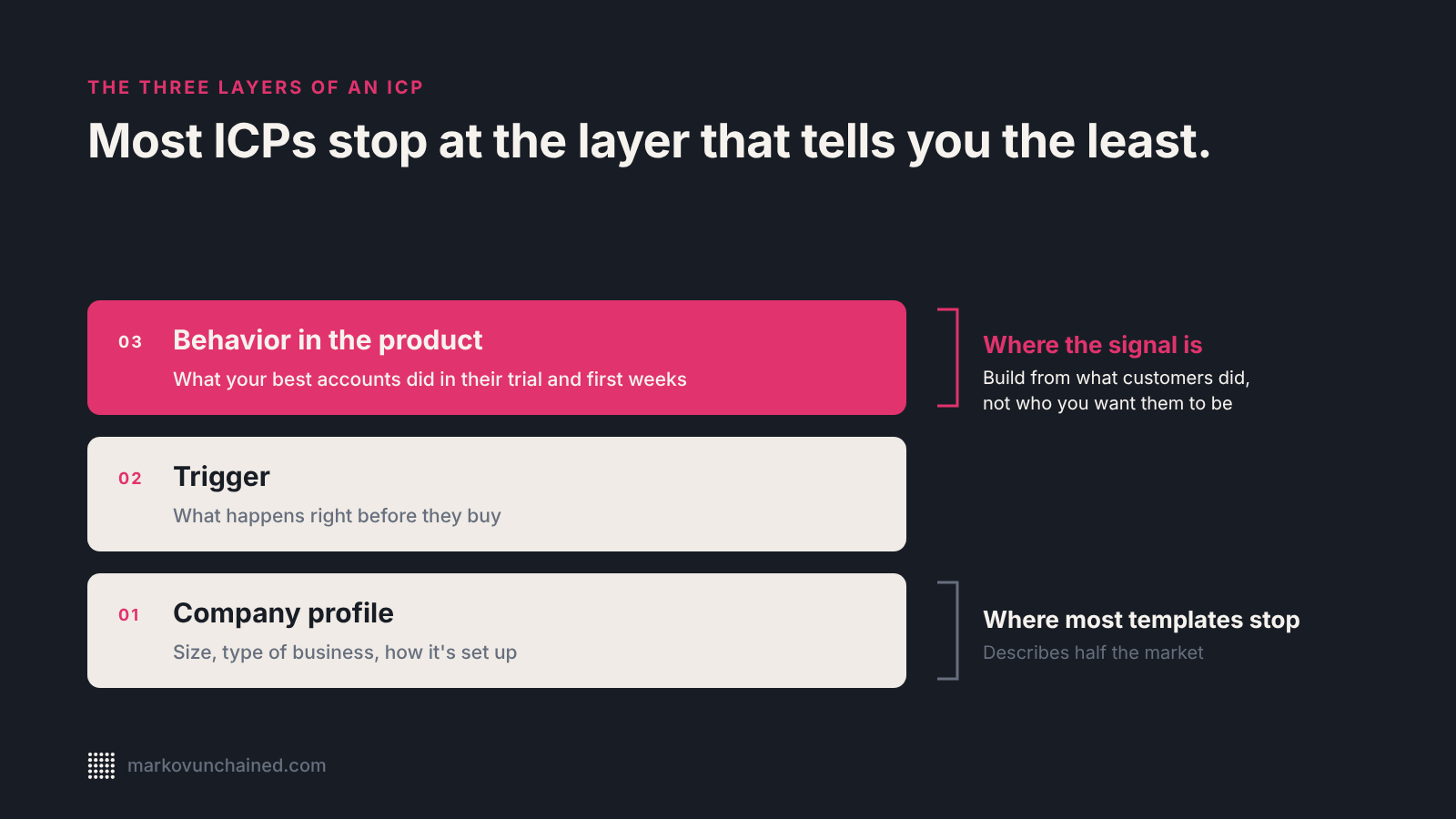
A good ICP has three parts: what the company looks like (size, type of business, how it's set up), what it does or experiences that makes it ready to buy (a trigger), and what it does once it's in your product. Most templates stop after the first part. That's how you end up with an ICP that describes half the market.
What's the difference between an ICP and a buyer persona?
The ICP tells you which companies to go after. The buyer persona tells you who to talk to inside them and what to say.
| ICP | Buyer persona | |
|---|---|---|
| Describes | A company | A person inside that company |
| Answers | "Is this a good customer for us?" | "How does this person buy, and what do they care about?" |
| Decides | Targeting, qualification, roadmap priorities | Messaging, sales conversations, content |
| Comes | First | Second |
If you build personas before the ICP, you end up with detailed portraits of people who work at companies that will never buy.
Why does an ICP matter for a B2B SaaS founder?
Because without one, every decision defaults to "yes", and "yes" to everyone is the most expensive strategy a small company can have.
You feel it in three places. Sales calls with companies that were never going to buy. A roadmap pulled in four directions by whoever asked loudest. And messaging so broad it fits no one – which usually ends with the only claim that's true for everyone: "we're cheaper." (More on that one below.)
How do you create an ideal customer profile? (step by step)
Start from what your best customers did, not from who you'd like your customers to be. The most common ICP mistake isn't bad research. It's aspiration: writing down the customer you want – the enterprise logo, the hot category – instead of the one that already pays you, stays, and expands.
1. Pull your won, lost and churned accounts
Export every closed-won deal, every lost deal, and every churned account you have. Twenty of each is plenty; if you have fewer, use what you have. You're looking for contrast, so the losers matter as much as the winners.
2. Sort the winners by outcome, not by logo
Rank the won accounts by what they did after buying: did they stay, expand, refer others, close fast? The impressive logo that churned in month four goes in the "lost" pile, whatever it did for your pitch deck.
3. Add what they did in the product
This is the step almost every guide skips, and it's the one that tells you the most. Look at what your best accounts did in their trial or first weeks – which features they used, how many people they invited, what they set up.
At Toggl, the accounts that converted to paid weren't defined by company size alone. They were the ones that used billable rates and advanced reporting during the trial. That shifted the ICP from company size toward how a company works: teams that bill clients for their time. We rebuilt onboarding to push trial users toward exactly those features.
4. Write the criteria
Combine the patterns into three groups: what the company looks like, what triggers it to buy, and what it does in the product. Aim for at least three specific attributes. If your ICP could describe a third of all B2B companies, it's too broad.
5. Write the disqualifiers
List the companies you'll turn away, even when they want to buy: too small, wrong use case, needs heavy customization, the problem is a nice-to-have. Jake Fuentes, who shut down his startup Cascade, put the cost of skipping this step plainly: "If you allow your ICP to fray, you'll lose." Without a rule for rejecting customers, you end up trying to serve all of them.
6. Test it in conversations
Talk to five to ten customers who fit the profile and a few who don't. You're checking one thing: does the problem you solve hurt more for the first group? If it doesn't, go back to step 3.
ICP template
Copy this and fill it in from steps 1–5. If a row stays empty, that's your next piece of research.
| Field | What goes in it | Illustrative example |
|---|---|---|
| Company profile | Size, type of business, how it's organized | Service firms with 50+ employees that bill clients by the hour |
| Behavior in the product | What your best accounts did in trial or onboarding | Set up billable rates and used client reporting in week one |
| Trigger | What happens right before they buy | A client disputes an invoice; a new finance lead asks for profitability by project |
| Pain, in their words | A sentence from a real call, unedited | "We don't know which projects make money until the quarter's over." |
| Disqualifiers | Who you turn away | Freelancers; teams that don't bill clients; anyone needing custom invoicing |
| Where they are | Communities, events, referral sources | Agency owner groups, accounting partners |
ICP example: what a B2B SaaS ICP looks like before and after
Before: When I joined Toggl, the website said it plainly: time tracking for everyone – freelancers, small companies, big companies.
After: Customer research with our product marketer narrowed it to two groups: agencies and professional-services firms with 50+ employees, and internal teams at large enterprises. Small customers could still sign up and pay on their own; above a set size, accounts went to sales.
The research took about two months. Getting the company to act on it took about two years – and that gap is what the rest of this article is about.
Why doesn't my ICP change anything?
Because agreeing with an ICP and acting on it are different things, and only the second one counts. Finding the right ICP is the easy part. Getting everyone to change what they do because of it is the hard part – and it doesn't happen unless the founder or leadership team drives it.
At Toggl, almost everyone agreed with the new ICP when we presented it. Then the feature proposals kept coming in for the old segments, as if the meeting had never happened. Nobody was being difficult. The old assumptions were still running the roadmap. It took two years of pushing before what we built matched what we'd agreed. The test is three questions:
🛠️ 1. Did it change the roadmap?
Name one feature you built, cut, or moved because of the ICP. Name one onboarding step that now pushes new users toward what your best customers do. If you can't, product is still building for everyone.
💬 2. Did it change the message?
Read your homepage headline. Would your ICP recognize their problem in it – and would a company outside your ICP feel slightly left out? If it works equally well for everyone, it hasn't changed.
The most common version of this: the ICP is well defined in the pitch deck – a specific type of company, a clear size range – and the homepage still leads with "we're cheaper." Price is the one claim that's true for every possible customer, which is exactly why it's what you write when the ICP hasn't reached the message. The fix is to lead with the specific outcome your ICP gets from the product, and keep price as the supporting reason instead of the headline.
🚫 3. Did it change who sales says no to?
Look at the last ten deals your sales process spent time on. How many were outside the ICP? At Toggl, the change was a rule: below a set size, customers bought on their own and sales stayed out; above it, sales took over. Sales time went to the accounts big enough to need it.
For every "no" in this test, make one change within 30 days. If none of the three changed, you don't have an ICP. You have a document.
What's different when you're the founder?
You don't have to convince three departments. You have to convince yourself – and that's harder than it sounds.
At a company without a marketer, the founder usually is the roadmap, the message and the sales "no", all in one head. That's an advantage: there's no one to persuade and nothing to wait for. It's also the trap. You're the one who takes the off-ICP deal because the quarter is thin, and the one who builds the feature because a big logo asked for it. Every exception feels reasonable on its own. Together, they're how an ICP frays.
For a founder, the ICP is mostly a tool for saying no to yourself. Write the disqualifiers down before the tempting deal shows up, not while it's on the table.
How do you know your ICP is working?
Watch the share of your pipeline that fits the ICP, not the size of the pipeline.
- Fit share: what percentage of new opportunities match the ICP? It should rise month over month.
- Win rate, ICP vs non-ICP: if the two are the same, your ICP isn't describing a real difference.
- Speed of "no": are you disqualifying bad-fit deals in the first call instead of the fourth?
Give it 90 days. If the fit share hasn't moved, the problem isn't the research. Someone – usually you – isn't acting on it.
The results take longer, and the ICP is never the only thing that changes. At Toggl, the growth rate went from about 4% a year to 40% over two years – the result of the ICP plus a long list of other changes across sales, onboarding and marketing, made by a whole team. The ICP didn't do that alone. But none of the other changes would have had a clear target without it. If your pipeline is full but nothing closes, the problem is pipeline conversion rate, not lead volume.
FAQ
How many attributes should an ICP have?
At least three, specific enough to exclude most of the market. "B2B SaaS companies" is one attribute and describes thousands of companies. "B2B SaaS companies with 20–100 employees, selling to finance teams, that recently hired their first salesperson" is three, and gives you a list you can work through.
How often should you update your ICP?
Review it every quarter against your won, lost and churned accounts. Change it when the data says so, not when a big prospect makes you want to. Rewriting it every month means none of the three changes ever has time to happen.
Can you have more than one ICP?
Yes, but each one needs its own message and its own sales rule, and a small team rarely has the capacity for more than two. Toggl had two. If you have five, you have none.
What's the difference between an ICP and a TAM?
Your total addressable market (TAM) is everyone who could buy. Your ICP is the slice of it you choose to win first. The ICP should be small enough to feel uncomfortable.
Where to start on Monday
Pull your won, lost and churned accounts, find what your best customers did in the product, and write the disqualifiers. Then run the three-change test on the ICP you already have. Most founders find they've done the research and skipped the hard part.
None of this is a silver bullet. An ICP doesn't fix a product people don't need, and enforcing one costs you deals in the short term – some of them good ones. That's the price of focus, and it's worth paying.
If you're a founder without a marketer and you'd rather not do this alone, this is where I usually start with the founders I work with: the research in the first two weeks, then making sure the roadmap, the message and the sales rules change with it. Grab a time here and bring your last ten deals – we'll see how many fit.