When to Hire Your First Marketer (and What They Need to Walk Into)
Hire your first marketer when what's left is execution, not strategy. A readiness test, who to hire, and what to have ready before day one.
By Ilia Markov, B2B SaaS Growth Leader & Advisor
I hear some version of this from almost every founder who still runs sales themselves. Usually the budget is already set aside. The job description is half-written. And the founder hesitates – not because they doubt marketing, but because they've heard enough stories about a first marketer who left within a year with little to show for it.
Those stories are rarely about a bad candidate. They're about what the candidate walked into. A first marketer who has to figure out who you sell to, what you say to them and which channel reaches them – all at once, alone, in their first quarter – is set up to fail before they open their laptop.
So the useful question isn't "should I hire a marketer?" It's "what will my first marketer walk into?" Get that right and the timing question mostly answers itself.
When should you hire your first marketer?
Hire your first marketer when what's left to do is mostly execution, not strategy. If you know who buys, why they buy and where at least some of them come from, a marketer can scale it. If you don't, a hire will spend months trying to find out – on your payroll, without your context.
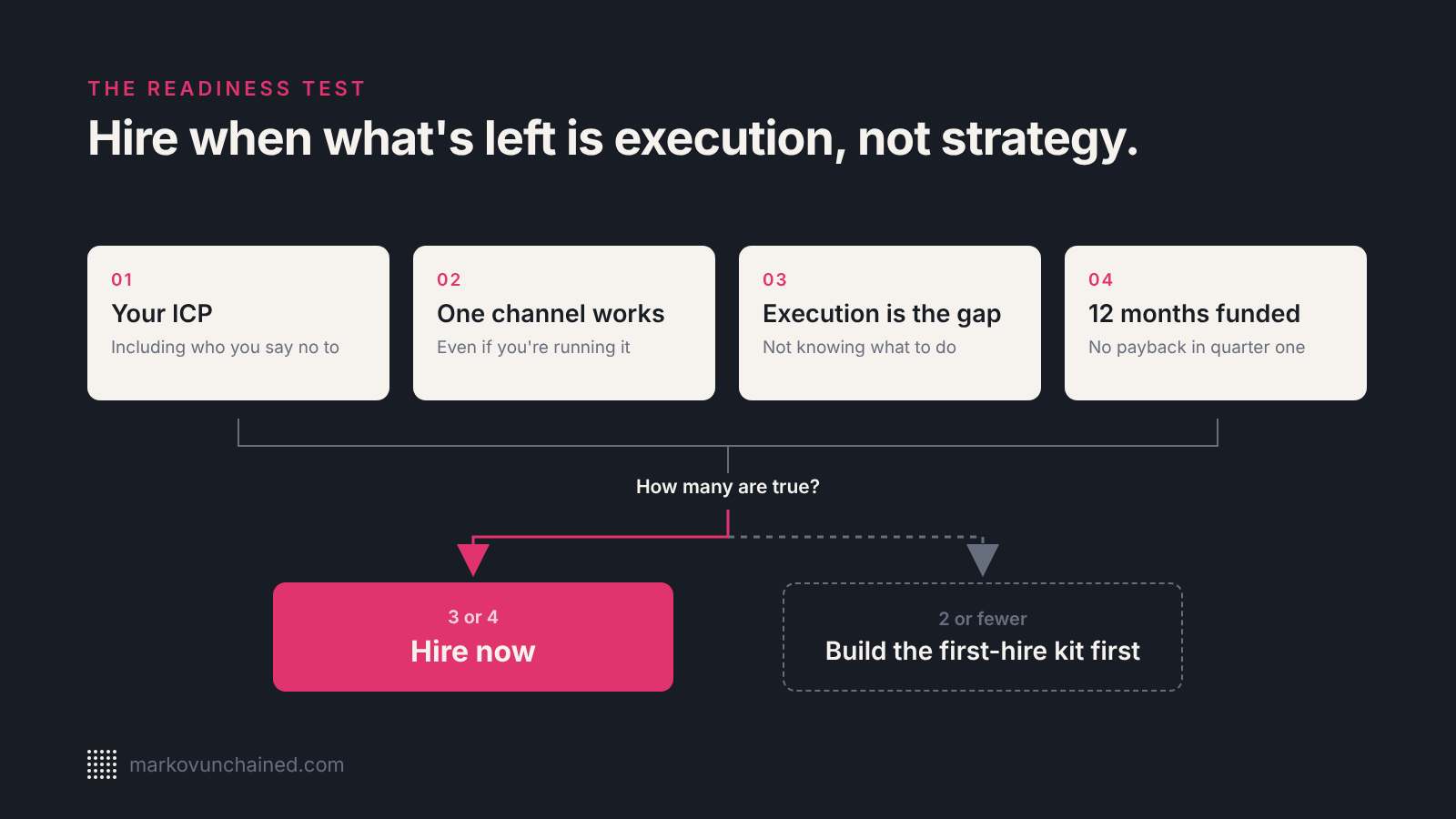
Here's the readiness test I use. You're ready to hire when at least three of these four are true:
- You can name your ICP – and who you say no to. Not "SMBs" or "tech companies". A segment specific enough that your sales calls with them feel alike, plus the kinds of companies you turn away.
- One channel already produces pipeline, even if you're the one running it. Founder outbound, referrals, a partner, a community – something has brought in qualified conversations more than once.
- You're the bottleneck on doing the work, not on knowing what to do. You have a list of things that would work if someone had time to do them. That's a hiring signal. "We should probably do some marketing" is not.
- You can fund the role for 12 months without it paying for itself in the first quarter. A first marketer who has to justify their salary by month three will chase whatever looks good on a dashboard, not what builds pipeline.
Three out of four: hire. Two or fewer: keep reading.
 ## What are the signs you're not ready yet?
A marketer can't stand in for a business strategy, and can't sell a product people don't want yet.
Two limits come before any readiness test. First, marketing amplifies whatever strategy you have. If you haven't decided which market you're going after and why you win there, a marketer will amplify the indecision. Second, no marketer can sell a product that hasn't found product-market fit. If customers try it and don't stay, more pipeline only means more churn a few months later.
Past those two limits, you're probably not ready if:
- Your best customers don't have much in common, and you're not sure which ones to find more of.
- Nothing repeats yet. Every deal came from a different place, mostly your network.
- You want someone to "figure out marketing" for you.
- You don't know which kind of marketer you need – and if you don't know that, you can't evaluate the candidates either.
None of this means a marketer can't help. A good one can run the customer research that gets you closer to product-market fit, and can help you shape the strategy. But they help you find it – they can't find it instead of you. If that's the job, hire for it on purpose: a senior, strategic profile, with you in the room for every decision – not an executor you expect to work it out alone.
Who should your first marketing hire be?
A hands-on generalist with one real strength, matched to what's missing – not a VP.
Emily Kramer's MKT1 newsletter has a useful name for the failure mode here: hiring someone with "too many firsts" – first time at an early-stage startup, first time owning strategy, first time with your business model, first time running the sub-function you need most. One or two is manageable. More than that at once and the learning curve eats the first year.
Which strength to look for depends on where you're stuck:
Your situationFirst hire to look forCustomers like the product but your messaging is fuzzyProduct marketer with some demand genPositioning is clear, but there aren't enough conversationsDemand gen generalistSelf-serve or product-led motionGrowth or lifecycle marketerTechnical product, technical buyersTechnical content or product marketer
Two things hold across all of them. They need B2B SaaS experience – the motion is different enough that learning it on your time is expensive. And they need to be comfortable doing the work themselves. A first marketer who expects to hire a team before shipping anything is solving next year's problem.
One exception: if your strategy is still open, the generalist profile breaks. You need someone senior enough to run the customer research and make positioning calls with you – and you should expect to pay for that seniority. It's the hire founders most often try to make cheaply.
How much does a first marketing hire cost?
More than the salary – and the hidden cost is the first quarter.
The salary is the visible part. The bigger cost is time: a recruiting process that can take two to three months, then a ramp-up where the hire learns your product, your customers and your sales process before they can change anything. If they also have to work out your ICP and positioning, that first quarter becomes two.
Add it all up – salary, taxes, tools, recruiting fees and the months before they're productive – and a senior first marketer in the US or Europe costs €/$10K+ a month all-in, often before they've shipped anything that moves pipeline.
That's the cost worth planning around. You can't make a good hire cheaper, but you can make their first 90 days productive instead of exploratory.
Should you hire full-time or get outside help?
It's not either/or. The best use of outside help before a first hire is to build what the hire will need.
Most advice frames this as a choice: a fractional marketer instead of a hire, or an agency instead of a team. That framing makes founders feel they have to pick one and defend it.
The more useful framing: outside help that settles the strategy questions – ICP, positioning, a baseline, a plan – makes the eventual hire better, faster. Outside help that only executes (writing posts, running ads) without that groundwork has the same problem a new hire does.
A strong senior hire can build the strategy too. The difference is time and risk. A hire builds it over their first two quarters, on a full salary, and you find out around month six whether they were the right person for it. Outside help can settle the same questions in weeks – and you learn what kind of marketer you actually need before you commit a year's salary to one.
Why do first marketing hires fail?
Because they inherit decisions nobody made.
Ask an AI assistant when to hire your first marketer and you'll get a sensible answer: hire when you can describe your ICP and positioning with confidence. A few lines later, the same answer suggests the new hire's first mandate should be to document the ICP and messaging.
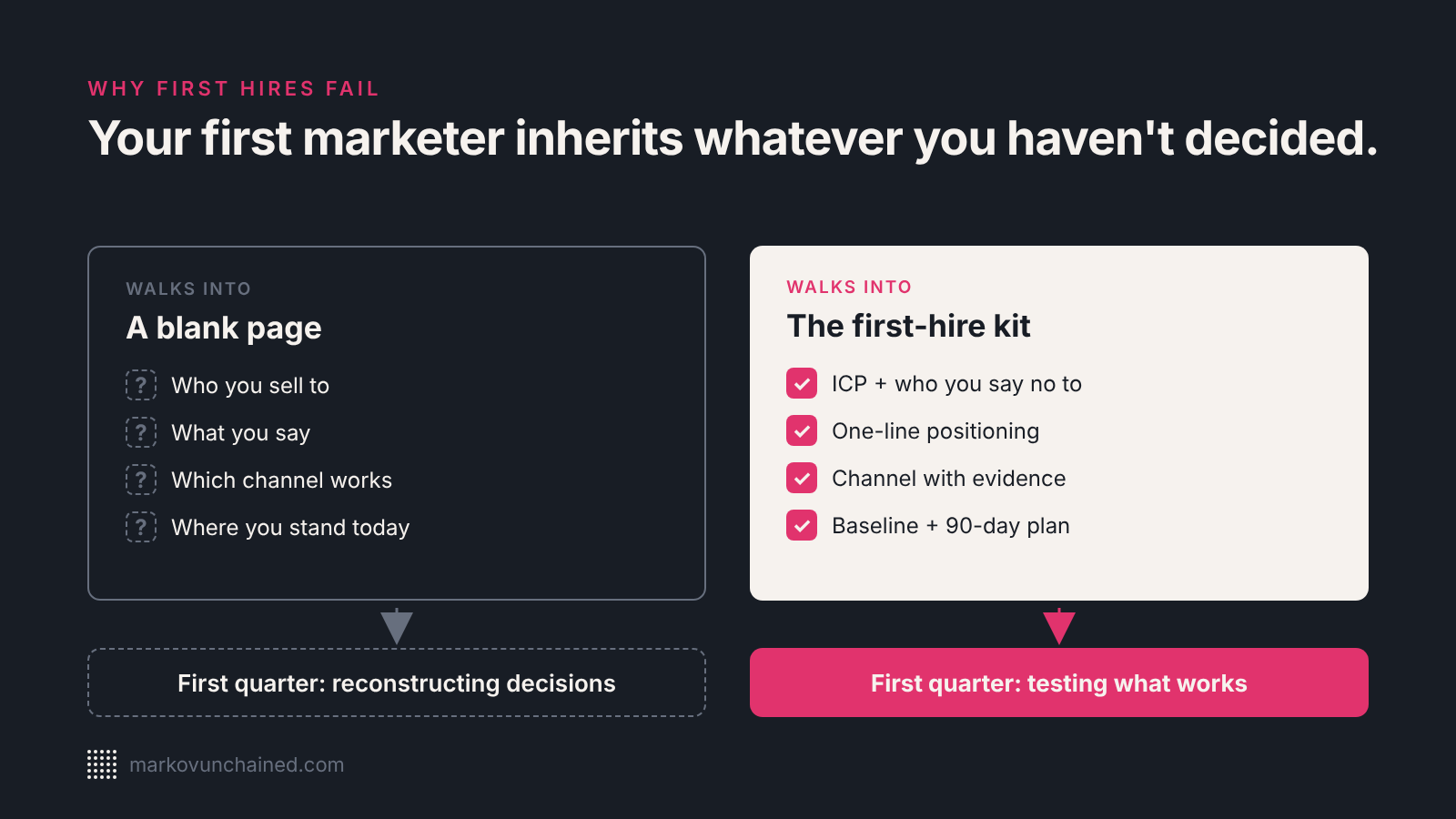
That contradiction is the most common way first hires go wrong. The founder believes the strategy is settled because it lives in their head. The hire arrives and discovers it isn't written down, the sales team describes the customer differently, and three segments are getting equal attention. So the marketer's first months go into reconstructing decisions – interviewing customers, rewriting the website, debating the ICP – while the founder wonders why pipeline hasn't moved.
When I'm brought in, the first weeks almost always go to the same questions: who exactly are we selling to, what do they believe before they buy, and which of our channels is producing anything real. If those answers exist, the work starts on day one. If they don't, the first month is archaeology.
 ## What should be ready before your first marketer starts?
Five things. Each can be done without hiring anyone – and each makes the hire better.
I call this the first-hire kit. None of it is complicated. All of it is usually missing.
1. Your ICP, including who you say no to
A one-page description of the segment you're focused on: company type, size, the trigger that makes them look for a solution, and the pain in their words. Then the part most founders skip – the companies you'll turn away, even if they'd pay. Without the "no" list, every inbound lead looks like a fit, and your new marketer will chase all of them.
For a step-by-step walkthrough and a template, see how to create an ideal customer profile.
2. A one-line positioning statement
Who it's for, what it replaces, and why you're the better choice for that customer. One sentence. If you and your co-founder write different sentences, you've found the first thing to fix.
3. A baseline
Where pipeline comes from today, what converts, how long deals take. It doesn't need a dashboard – a spreadsheet of your last 20 closed deals with source and cycle length is enough. Without a baseline, your hire can't show progress, and you can't judge whether they're making any.
If you want to measure it properly from your CRM, start with your pipeline conversion rate.
4. A candidate scorecard
If you're not a marketer, interviews tend to reward whoever tells the best story. A scorecard fixes that. Write down the three to four outcomes the role must deliver in its first six months, then score each candidate on evidence that they've delivered something similar before – not on how well they describe it. Add the "too many firsts" check: how many of the things this role needs would be firsts for them?
5. A 90-day plan
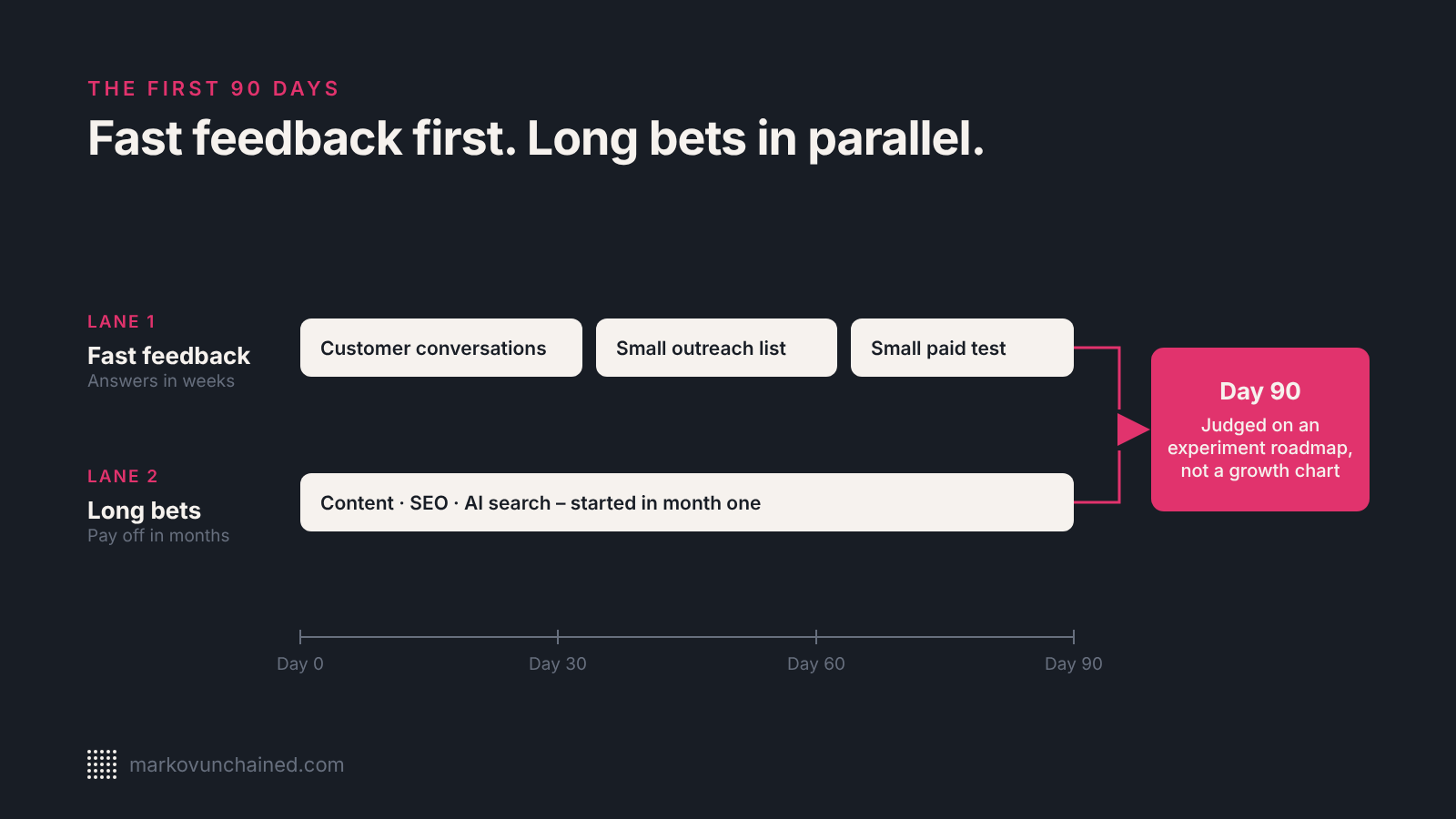
Not a marketing plan for the year – a plan for the first quarter. Mine always has the same shape:
- Fast feedback first. Customer conversations, targeted outreach to a small list, a small paid test – things that tell you within weeks whether the message lands.
- Long bets seeded in parallel. Content, SEO and AI-search visibility take months to pay off, so they start in month one, not month four.
- Judged on a working experiment roadmap, not on growth. At day 90, the question is "do we know what works and what doesn't, with evidence?" – not "did pipeline double?"
A hire who starts with this plan spends their first quarter testing. A hire who starts without it spends it planning.
 ## How do you know it's working?
At 90 days, look for evidence, not growth.
Your first marketer is on track if, by the end of their first quarter, they can show you which experiments ran, what each one taught you, and what they'd double down on. Pipeline may not have moved yet. That's fine if the reasons are documented and the next quarter's bets are sharper than the first.
They're off track if they're still debating the ICP, still rebuilding the website, or reporting on traffic and impressions instead of conversations and opportunities.
FAQ
Should my first marketer be senior?
Senior enough to make decisions without you, hands-on enough to do the work. A head of marketing who wants a team before shipping anything is the wrong first hire.
Should I hire a generalist or a specialist?
A generalist with one real strength. Pick the strength based on your biggest gap – messaging, pipeline, or activation.
Can the founder keep doing marketing instead?
Up to a point. Once you know what works and you're the bottleneck on doing it, keeping marketing on your plate costs you time on sales and product.
What should a first marketer do in their first 90 days?
Run fast-feedback experiments, seed long-term bets like content, and finish the quarter with an evidence-backed view of what works.
Where to start on Monday
Run the readiness test. If you score three or four, start writing the scorecard before you post the job. If you score two or fewer, work through the first-hire kit first – your eventual hire will thank you, and you'll know exactly what you're hiring for.
None of this guarantees a great hire. Good candidates still turn out to be wrong fits, and some strategy questions only get answered by running the experiments. But a first marketer who walks into settled decisions and a clear 90-day plan has a fair shot. One who walks into a blank page mostly doesn't.
This is the first thing I work through with founders who don't have a marketer yet – settling the ICP, positioning and plan so the hire, whenever it happens, starts on day one. If you're weighing that decision now, I'm happy to compare notes.